
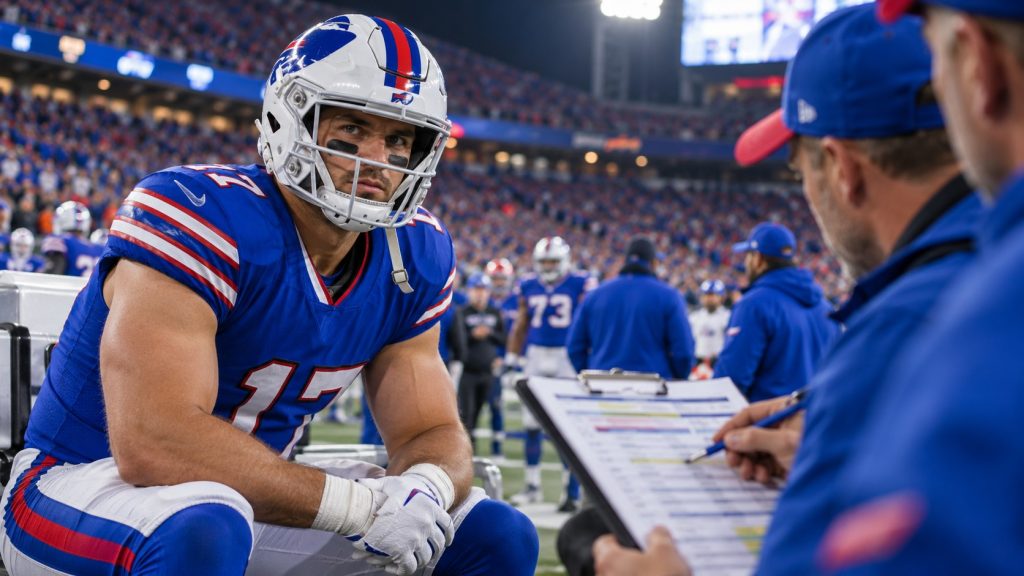
The Buffalo Bills could have a path to a major trade before the 2026 NFL trade deadline without releasing players to create salary-cap space. However, the latest publicly reported figures suggest their financial flexibility is tighter than the $4.5 million figure highlighted in the headline.
In its October 22 trade-deadline analysis, NFL.com listed Buffalo with approximately $3.85 million in available salary-cap space, citing Over the Cap. That figure is a more recent reference point than $4.5 million, although cap estimates can change as teams make roster and contract transactions.
The distinction matters because a player’s advertised contract value and the amount a team must accommodate on its salary cap for the remainder of a season are not necessarily the same. With the November 10 deadline approaching, Buffalo could explore several financial mechanisms to pursue an upgrade without immediately sacrificing a player from its existing roster.
There is an important caveat: a trade involving a player described as having a $9 million cap figure would not automatically fit within Buffalo’s available space. The player’s remaining salary obligations, existing bonus structure and any negotiated financial contributions from the trading team would determine whether the transaction was feasible.
Why a $9 Million Contract Does Not Always Require $9 Million in New Cap Space
NFL teams must account for the financial obligations attached to a player when acquiring his contract. A player’s full-season cap number, however, does not tell the entire story of what a new team must accommodate in a trade completed during the regular season.
Generally, the acquiring team assumes responsibility for the player’s remaining base salary and applicable contract obligations. Previously prorated signing-bonus amounts normally remain with the original team, while the precise accounting depends on the contract and transaction terms.
That creates an opportunity for teams to target players whose contracts appear expensive on paper but carry a manageable remaining obligation. For Buffalo, the critical calculation would be whether the incoming player’s cap charge, after accounting for the applicable roster replacement and transaction details, fits within its available room.
For example, a player with a $9 million annual cap figure might have substantially less than $9 million remaining in current-season salary obligations when traded. Nevertheless, Buffalo could not assume that every player carrying such a figure would be affordable. A contract with substantial remaining base salary or roster bonuses could still exceed the team’s available space.
This is where the difference between a player’s annual contract value and his immediate salary-cap cost becomes important. It can expand Buffalo’s list of potential trade targets, but it does not remove the NFL’s salary-cap restrictions.
Could a Contract Restructure Create the Necessary Room?
One potential route would be restructuring an existing contract rather than releasing a player. Under a typical NFL restructure, a team converts an eligible portion of a player’s base salary into a signing bonus, allowing the cap charge to be distributed across the remaining contract years, subject to league rules.
Over the Cap’s current Buffalo Bills transaction estimates identify offensive tackle Dion Dawkins as one possible source of substantial cap relief. The site’s calculations list a potential 2026 cap saving of approximately $11.37 million through a restructure of Dawkins’ contract.
That number represents a theoretical maximum based on the site’s contract calculations, not an announced Bills transaction or confirmation that Buffalo intends to pursue that option. Any actual restructure would depend on the contract’s applicable terms and the final accounting.
Still, the estimate illustrates why limited cap space does not necessarily mean Buffalo has exhausted its options. A restructure could provide enough room to consider a more expensive acquisition without requiring the team to release a productive player simply to make the numbers work.
The trade-off is that restructuring does not eliminate the underlying financial obligation. It shifts cap charges into future seasons, potentially making later roster decisions more difficult. Buffalo would need to weigh the immediate competitive benefit against the long-term cost.
A Second Option: Negotiating With the Trading Team
Buffalo could also negotiate a deal in which the team trading away the player agrees to pay some of his remaining base salary. The NFL permits teams to negotiate financial arrangements that help an acquiring club fit a contract under the salary cap.
Such an agreement could lower Buffalo’s immediate financial burden and make a player attainable without cutting anyone from its roster. However, the selling team would have to agree to absorb that expense, and it could demand stronger draft compensation or other value in return.
That creates a separate decision for general manager Brandon Beane. A deal that solves the salary-cap problem may still be unattractive if the acquisition cost is excessive. Buffalo would have to evaluate the player’s expected impact, remaining contract, health and future financial commitments against the assets required to complete the trade.
It is also important to distinguish between preserving roster players and preserving every team asset. Buffalo might avoid releasing a current player for cap relief, but a blockbuster trade could still require draft picks or other compensation. Financial flexibility does not make a trade free.
Why the Bills’ Defensive Needs Could Shape the Decision
NFL.com’s October 22 analysis identified the secondary as an area of concern for Buffalo heading into the deadline. That gives the Bills a potential football reason to explore the market, but it does not establish that the team is pursuing a particular player or preparing a $9 million deal.
A meaningful addition would need to address a specific defensive weakness, fit the coaching staff’s scheme and offer an improvement over the team’s existing options. A recognizable name or an attractive contract structure alone would not justify surrendering valuable draft capital.
The front office must also consider availability. Teams with playoff ambitions may be reluctant to move established starters, while sellers could demand a premium for players who can immediately strengthen a contender. Buffalo’s limited starting cap space may make less expensive alternatives or carefully negotiated agreements more practical than an unrestricted pursuit of the biggest names.
What Buffalo Must Get Right Before November 10
The 2026 NFL trade deadline is scheduled for November 10 at 4 p.m. Eastern Time. Before that cutoff, Buffalo has three broad options: target a player whose remaining salary fits its existing cap room, restructure an eligible contract to create additional space, or negotiate a trade that includes a contribution toward the player’s unpaid salary from the selling team.
The best solution would depend on the specific contract and the value of the player being acquired. Buffalo would also need to account for any additional cap charges associated with the transaction and remain compliant with the league’s rules.
There is no confirmed $9 million blockbuster trade in the information currently available that establishes Buffalo is preparing such a move. The financial mechanisms described here demonstrate what the Bills could potentially explore, rather than reporting that a deal is imminent.
Ultimately, the salary-cap situation is a limitation, not an automatic barrier to making a significant addition. Buffalo could potentially pursue an upgrade without releasing an existing player, but doing so would require precise contract calculations, a willing trade partner and a clear judgment that the football benefits outweigh the financial and draft-pick costs.
Discussion
0Be the first to share your thoughts on this story.