
The Buffalo Bills are heading into their Week 7 bye with a 5–1 record, but the story behind their strong start goes beyond the familiar names on the roster. Several members of Buffalo’s 2026 rookie class have begun carving out meaningful roles, particularly on defense and special teams.
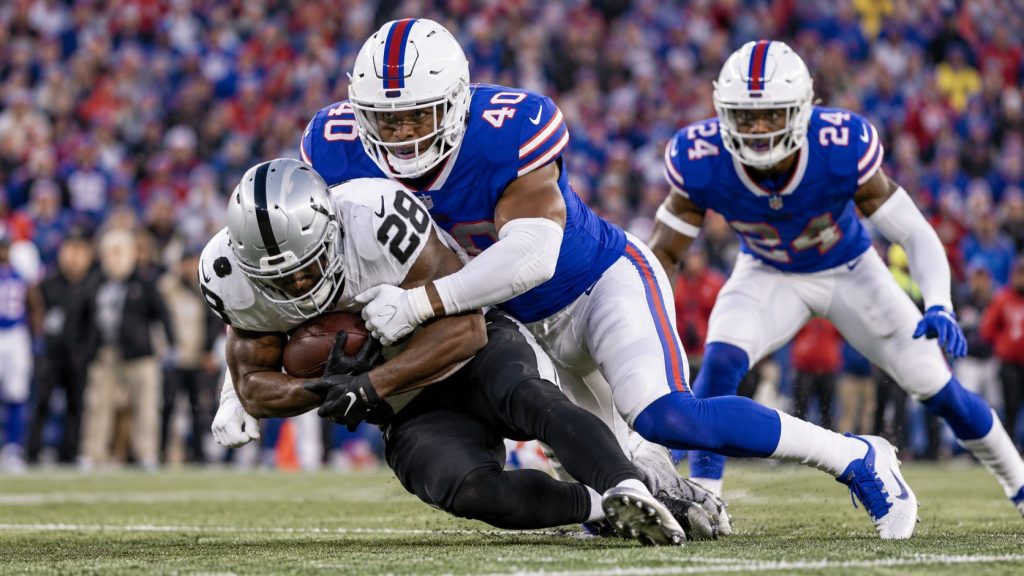
Buffalo’s 33–30 victory over the Las Vegas Raiders on October 18 provided another opportunity to evaluate how much the newcomers have contributed. Rookie cornerback Davison Igbinosun continued to make plays in coverage, while edge rusher T.J. Parker received an expanded workload. Punter Tommy Doman Jr. has also quietly established himself as a reliable part of the team’s special-teams operation.
The phrase “saved their season” might be an overstatement. Quarterback Josh Allen and Buffalo’s established veterans remain central to the team’s success. Still, the rookies are providing valuable depth and early production as the Bills prepare for the demanding stretch ahead.
This ranking considers regular-season performance through Week 6, playing time, consistency and each player’s importance to his position group. Because Buffalo has played only six of its 17 regular-season games, these grades represent an early-season assessment rather than a final verdict on the draft class.
1. Davison Igbinosun, Cornerback
Grade: A-
Igbinosun has made the strongest overall case to be considered Buffalo’s most impactful rookie so far. The second-round selection from Ohio State has appeared in all six games, started three and recorded 27 combined tackles and seven passes defended through Week 6.
His performance against Las Vegas was particularly encouraging. Igbinosun finished with two tackles and three pass breakups, demonstrating his ability to disrupt throws even when opposing offenses tested Buffalo’s secondary. His seven passes defended are an important indicator of his growing involvement in coverage, while his tackle production reflects a willingness to contribute after the catch.
The numbers do not mean he has eliminated the mistakes that can accompany a young cornerback learning the professional game. However, his growing responsibilities suggest Buffalo is comfortable giving him meaningful opportunities against NFL receivers.
Igbinosun’s importance extends beyond the statistics. Developing a young cornerback who can compete for regular snaps gives the Bills additional flexibility in their defensive backfield. With opposing passing attacks continuing to test the defense, that development could become increasingly valuable over the second half of the season.
Verdict: Igbinosun is the clear leader of Buffalo’s rookie class at this checkpoint. His coverage production and growing role have already translated into tangible contributions.
2. T.J. Parker, Edge Rusher
Grade: B+
Parker, Buffalo’s second-round selection from Clemson, is beginning to look like an important piece of the pass-rush rotation. Through the first six games, he has registered 16 combined tackles, half a sack and one forced fumble.
His workload against the Raiders offered a particularly useful indication of his progress. Parker played 41 of Buffalo’s 66 defensive snaps, approximately 62 percent of the total. Veteran edge rusher Bradley Chubb played 21 defensive snaps in the same game after briefly leaving with a rib injury before returning.
The difference in playing time should not automatically be interpreted as a permanent change in the depth chart. Chubb’s injury situation affected the game, and one performance does not establish who will lead the rotation going forward. Nevertheless, Parker’s increased involvement gave him valuable experience in a close road victory.
His production is still developing. Half a sack is not the kind of pass-rushing total that transforms a defense, but tackles, pressure opportunities and the ability to handle a larger snap count can help establish a foundation. Buffalo needs its young edge defenders to become more consistent as the schedule progresses.
The next step for Parker is turning those opportunities into more disruptive plays against opposing quarterbacks. His early workload makes him one of the rookies worth watching after the bye.
Verdict: Parker has not become a dominant pass rusher yet, but his growing role and early production put him firmly among Buffalo’s most encouraging newcomers.
3. Tommy Doman Jr., Punter
Grade: B+
Doman’s contribution is less visible than a defensive stop or a highlight-reel play, but field position can make a substantial difference over the course of a season. The seventh-round rookie won Buffalo’s punting job during training camp and has handled the role through the first six games.
Doman has recorded 12 punts for 584 yards, averaging 48.7 yards per punt. Six of those attempts have landed inside the opponent’s 20-yard line, while his net average stands at 46.0 yards. His longest punt has traveled 63 yards, and none of his punts has been blocked.
Those figures provide a promising start, although a 12-punt sample is too small to establish a definitive judgment on his long-term consistency. His net average and ability to place punts inside the 20-yard line are especially relevant because they help the defense begin its work with the opposition farther from the end zone.
Buffalo’s offense has generally given the team plenty of scoring opportunities, but even strong offenses occasionally need their punter to change the field-position equation. Doman has shown that he can fill that role without requiring the coaching staff to make an early-season change at the position.
Verdict: Doman has delivered a steady start in a specialized role. He may not dominate highlight packages, but his field-position contributions belong in any honest evaluation of Buffalo’s rookie class.
4. Kaleb Elarms-Orr, Linebacker
Grade: B-
Fourth-round pick Kaleb Elarms-Orr has quietly built a useful statistical foundation while adjusting to the speed and complexity of the NFL. Through six games, the TCU linebacker has recorded 12 combined tackles, including five solo tackles, and one pass defended.
Elarms-Orr has not yet established himself as a full-time starter, and his role remains smaller than those of the highest-ranked rookies. He played 22 defensive snaps against Las Vegas, approximately one-third of Buffalo’s defensive workload in that game.
That playing time matters because it gives the coaching staff an opportunity to evaluate him against professional offenses while allowing the team to manage his development. His tackle totals show that he has been involved in defensive plays, but his next challenge is demonstrating that he can contribute consistently in a wider range of situations.
The Bills will need depth at linebacker as the schedule becomes more demanding. A young player who can handle rotational responsibilities, execute assignments and avoid costly mistakes can offer value even without accumulating sacks or interceptions.
Verdict: Elarms-Orr remains a developing contributor rather than a breakout star. The early tackling production is encouraging, but his overall impact will depend on how his role evolves.
5. Skyler Bell, Wide Receiver
Grade: Incomplete
Skyler Bell’s place on this list requires an important distinction: opportunity is not the same thing as production. The fourth-round pick from Connecticut has appeared in Buffalo’s past two games after sitting out the first four weeks of the regular season.
Bell has not recorded a reception on his three regular-season targets. In the Week 6 win over Las Vegas, however, he played 30 of Buffalo’s 68 offensive snaps, approximately 44 percent. That workload suggests the coaching staff is giving him a chance to become a more regular part of the receiving rotation.
His college résumé provides a reason for patience. Bell led Connecticut with 101 receptions, 1,278 receiving yards and 13 receiving touchdowns during the 2025 college season. Those accomplishments established his potential, but translating them into NFL production requires adjustments to professional coverage, timing and route execution.
The upcoming stretch will be an important test. If Bell begins converting targets into catches and earns a consistent role, his ranking could improve quickly. For now, though, it would be premature to describe him as a player who has rescued Buffalo’s season.
Verdict: Bell is a watch-list candidate, not yet a proven contributor. His increased playing time is worth monitoring, but the production must follow.
Where the Rest of the Rookie Class Stands
Safety Jalon Kilgore has recorded one tackle in two regular-season appearances. He played 11 defensive snaps against Las Vegas, giving him some exposure to the defensive rotation, but he has not yet accumulated enough production to rank alongside the leading rookies.
Offensive lineman Jude Bowry has not appeared in a regular-season game through Week 6. His development remains a longer-term consideration while Buffalo relies on its established offensive-line options. Defensive tackle Zane Durant, another member of the 2026 draft class, was placed on injured reserve before the regular season and has not been available to contribute.
These situations are not necessarily evidence of draft failures. Rookie development timelines vary considerably, particularly for offensive linemen and defensive players who need time to learn complex assignments. The relevant question is whether each player can progress toward a useful role when opportunities arrive.
Have the Bills Rookies Actually Saved the Season?
Not by themselves. Buffalo’s 5–1 record reflects contributions from established players as well as the newcomers. Allen’s ability to generate offense and the production of the veteran core remain central to the team’s strong start.
The defense also has room to improve. Buffalo allowed 313 passing yards against Las Vegas, despite leaving with a three-point victory. That performance illustrates why promising rookie contributions should be viewed as part of the solution rather than evidence that the defensive unit has already reached its potential.
Igbinosun currently deserves the top spot because his combination of tackles, pass breakups and regular playing time has made the most visible difference among the rookies. Parker is the next most compelling prospect because his defensive workload is growing, while Doman has quietly handled an important special-teams assignment. Elarms-Orr has made useful rotational contributions, and Bell remains a player whose opportunity needs to produce results.
The Bills return from their bye to face the Baltimore Ravens on November 1. That matchup will provide another test for a team aiming to turn a strong start into sustained success. For Buffalo’s rookie class, the immediate objective is straightforward: keep earning snaps, improve consistency and turn early promise into dependable production.
At this stage, the rookies have not saved Buffalo’s season on their own. They have, however, begun providing useful support in areas where the team needs depth and development. If Igbinosun and Parker continue to progress while Doman maintains his early efficiency, Buffalo could receive even greater value from its 2026 draft class as the season moves forward.
Discussion
0Be the first to share your thoughts on this story.