
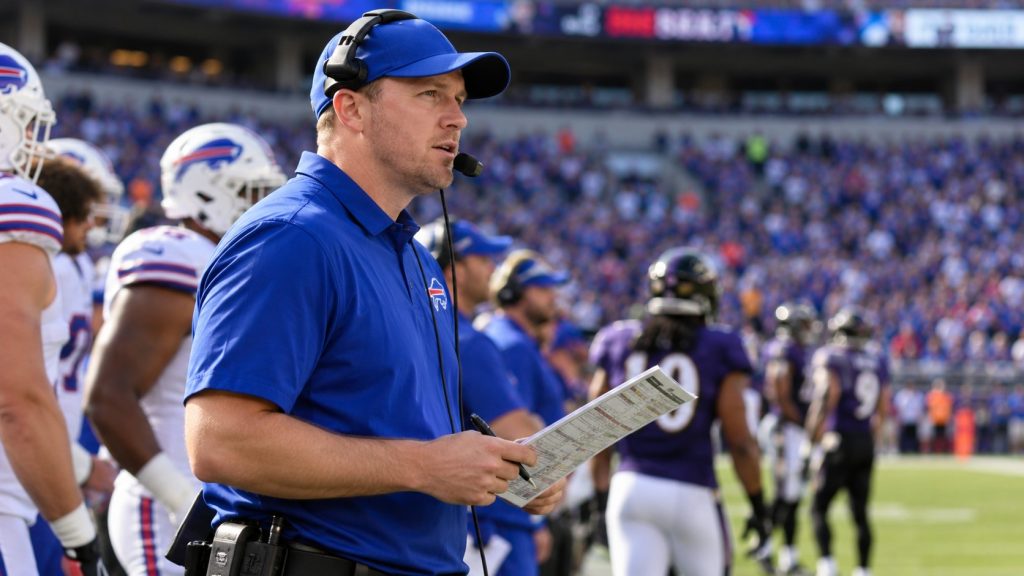
The Buffalo Bills are 5-1, leading the AFC East and averaging more points per game than any other team in the NFL. On paper, Buffalo has every reason to feel confident heading into its Week 8 matchup against the Baltimore Ravens. Head coach Joe Brady, however, is not interested in letting the win-loss record hide the problems that could cost his team when the stakes get higher.
Brady’s message during the Bills’ bye week was direct: a winning record does not mean everything is working. Buffalo has an explosive offense led by quarterback Josh Allen, but inconsistent defensive stops, turnovers and penalties have left too much room for opponents to stay competitive. Those issues will be difficult to ignore when the Bills host Baltimore on Sunday, November 1, at Highmark Stadium.
“I’m not happy with how the team’s playing right now,” Brady said, making it clear that the coaching staff expects more from all three phases of the game. It is the kind of message a contender needs to hear before the regular season moves into a more demanding stretch. Winning is important, but the ability to win consistently without relying on late-game heroics is what separates a good team from a serious Super Bowl threat.
The 5-1 Record Does Not Tell the Whole Story
Buffalo’s offensive production has been one of the biggest reasons for its strong start. Through six games, the Bills have scored 197 points, an average of 32.8 per contest. Allen has thrown for 1,504 yards and nine touchdowns, giving the offense a reliable foundation to attack defenses through the air. Running back James Cook has also been productive, recording 627 rushing yards and six touchdowns while averaging 5.4 yards per carry.
The balance between Allen’s passing ability and Cook’s effectiveness on the ground gives Buffalo several ways to control a game. When the offensive line creates running lanes and Allen protects the football, the Bills can make defenses defend the entire field. That versatility should remain a major advantage against Baltimore, particularly if Buffalo can establish the run early and avoid predictable passing situations.
Still, offensive production has not eliminated every concern. The Bills enter the matchup with a minus-three turnover differential, a reminder that possessions can disappear even when the offense is capable of producing points. Penalties and other avoidable mistakes have also disrupted drives. Against a team with Baltimore’s talent, giving away possessions or extending an opponent’s drive through a penalty can quickly change the game.
The important distinction is that Buffalo does not need to reinvent its offense. It needs to make its existing strengths more dependable. Allen does not have to attempt a spectacular play on every possession, and the offense cannot afford to turn manageable situations into difficult third downs through careless penalties or preventable mistakes. Better decisions and cleaner execution could make an already productive unit even harder to stop.
Buffalo’s Defense Must Match the Offense’s Standards
The defensive numbers provide the clearest explanation for Brady’s frustration. Buffalo has allowed 171 points through six games, an average of 28.5 per contest. Opponents have also accumulated 2,321 total offensive yards during that stretch. For a team with ambitions of competing deep into January, those figures point to a problem that cannot be covered up by offensive fireworks every week.
Third-down execution is another area worth watching. Opposing offenses have converted 36 of their 80 third-down attempts against Buffalo. That means the defense has not consistently finished drives when given an opportunity to get off the field. Allowing opponents to sustain possessions places additional pressure on the secondary, keeps the defense on the field and limits the number of opportunities Allen and the offense receive.
The matchup against Baltimore makes those concerns particularly relevant. Running back Derrick Henry can punish a defense that misses tackles or loses discipline against the run, while wide receiver Zay Flowers can turn short completions into significant gains. The Bills must tackle efficiently, maintain their responsibilities and prevent Baltimore from repeatedly creating favorable situations on second and third down.
Defensive coordinator Jim Leonhard will need his unit to complement the offense rather than simply try to survive until Allen can produce another scoring drive. Buffalo does not necessarily need a shutout or a dominant defensive performance. It needs timely stops, fewer explosive plays allowed and the ability to force Baltimore to settle for field goals instead of touchdowns.
Lamar Jackson’s Status Adds Another Layer to the Challenge
Baltimore enters Week 8 at 4-3 after losing its past two games. The Ravens fell 13-10 to the Cleveland Browns on October 18 before suffering a 35-13 defeat against the Cincinnati Bengals on October 25. Their recent results have exposed offensive difficulties, particularly during the second half of games without their starting quarterback.
Lamar Jackson has missed the past three games with a high left ankle sprain sustained against the Tennessee Titans on October 4. Ravens head coach Jesse Minter expressed optimism on October 26 that Jackson could return against Buffalo, but said the team would have a clearer picture after Wednesday’s work. His availability remains an important factor in preparing for Sunday’s contest, and the situation should not be treated as settled before the teams provide further updates.
Without Jackson, backup quarterback Tyler Huntley has started three consecutive games. He threw for a career-best 298 yards against Cincinnati, but Baltimore has averaged 17.7 points during his three starts. The Ravens also failed to score in the second half of their past two games, a troubling pattern they will need to address regardless of who plays quarterback against Buffalo.
If Jackson returns, Buffalo will face a substantially different challenge. His passing ability and running threat force defenses to account for more possibilities on every play. The Bills would have to maintain their assignments, keep contain responsibilities intact and avoid giving Jackson easy opportunities to extend plays. If Huntley starts instead, Buffalo must still respect Baltimore’s running game and avoid assuming that the quarterback situation alone will determine the result.
The Bills should prepare for both possibilities rather than build their entire game plan around the expectation that Jackson will be unavailable. His status will influence the matchup, but Buffalo’s ability to tackle, communicate and execute its assignments remains within its control.
Why the Bye Week Matters for Joe Brady
Buffalo’s Week 7 bye arrived after a demanding opening stretch that included close games against the New England Patriots, Los Angeles Rams and Las Vegas Raiders. The Bills lost 29-26 to New England on October 4, then responded with a 37-34 overtime victory over the Rams and a 33-30 win over Las Vegas. Those results demonstrate Buffalo’s ability to finish tight games, but they also show how frequently the team has needed to operate under pressure.
The time away from competition gave the coaching staff an opportunity to review those performances, address communication problems and emphasize the details that can determine close games. The break also provided injured players with additional recovery time. Defensive tackle Ed Oliver and wide receiver D.J. Moore were among the players Buffalo hoped to get back after they missed the previous two games, although their availability for Baltimore must be confirmed through the week’s injury reports.
Brady’s challenge is to turn the bye week into measurable improvement. The offense must reduce its avoidable mistakes, the defense must finish more possessions and special teams must prevent small errors from creating favorable field position for the opposition. A team cannot control every bounce of the ball, but it can control how often it puts itself in difficult situations.
That message is especially important for a first-year head coach. Brady was named Buffalo’s head coach on January 27, 2026, after serving as the team’s offensive coordinator during the 2024 and 2025 seasons. His familiarity with Allen and the offensive system gives him a strong starting point, but establishing consistent standards across the entire roster is a separate responsibility from calling plays for a productive offense.
Baltimore Will Test Whether Buffalo Has Learned Its Lesson
The Ravens offer a meaningful test because they have enough individual talent to exploit mistakes, even while dealing with their own problems. Henry can force defenders to make difficult tackles, Flowers can stretch the field, and Jackson’s potential return would add another dimension to the offense. Buffalo cannot assume that Baltimore’s recent defeats will carry over into Sunday’s game.
For the Bills, the most important objective is to make the game less chaotic. Allen and Cook should be able to give the offense a strong platform, but the defense needs to create stops without relying on turnovers to rescue possessions. Buffalo also needs to avoid penalties that give Baltimore free yardage and preventable opportunities to extend drives.
The coaching staff should pay particular attention to how Buffalo responds when the Ravens make a run. Strong teams do not abandon their plan after one bad series or one explosive play. They communicate, adjust and return to the fundamentals. That is the kind of discipline Brady is demanding when he insists that a 5-1 record is not enough to prove the team is playing to its potential.
Sunday’s game is scheduled for 1 p.m. Eastern Time on November 1 at Highmark Stadium. With Buffalo coming off its bye and Baltimore looking to halt a two-game losing streak, both teams have reasons to view the matchup as an important early-season test.
The Bills have already shown that they can score enough points to beat quality opponents. The next step is proving they can win while limiting the mistakes that make games unnecessarily difficult. Brady’s reality check is not a rejection of Buffalo’s 5-1 start. It is an acknowledgment that the record is only part of the story.
If the Bills clean up their penalties, protect the football and improve their defensive execution, their strengths become much more sustainable. If the same problems continue, even an elite offense may struggle to compensate every week. That is why Brady’s message matters before Baltimore: Buffalo does not need to be satisfied with winning. It needs to become a more complete team.
Discussion
0Be the first to share your thoughts on this story.