
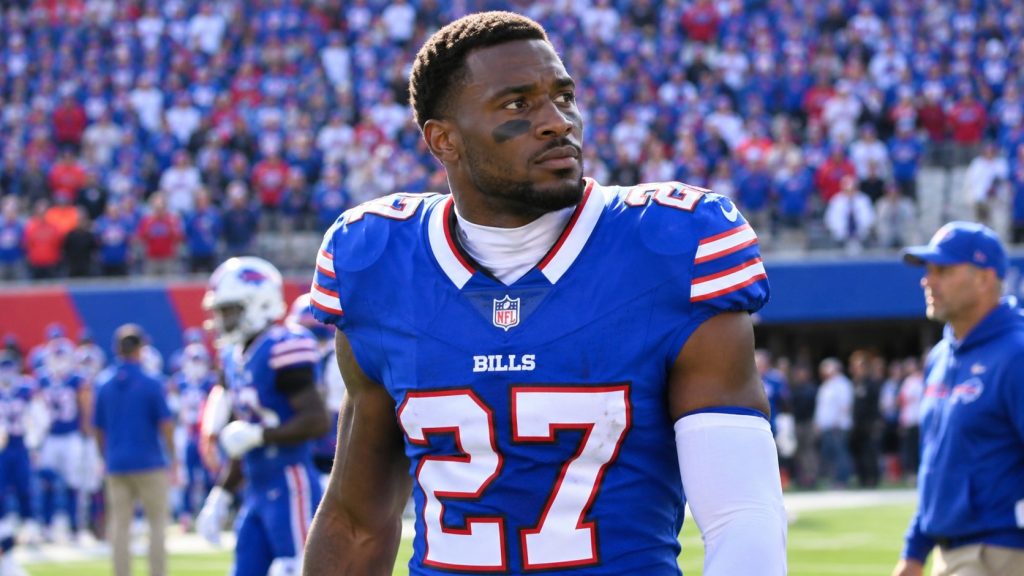
The Buffalo Bills are turning to a familiar face as they look to address one of their biggest weaknesses during the 2026 NFL season. Veteran cornerback Tre’Davious White has returned to Buffalo, signing with the team’s practice squad on October 19 and giving the struggling secondary another experienced option ahead of the second half of the season.
White’s return comes at a critical moment. Buffalo enters its Week 7 bye with a 5-1 record and leads the AFC East, but its defensive performances have raised serious questions about whether the team can maintain its momentum against stronger opponents. While Josh Allen and the offense continue to produce points, the defense has repeatedly struggled to keep opposing teams off the scoreboard.
The reunion offers Buffalo a potentially valuable reinforcement, but it also raises an important question: Is bringing back White a smart move that could stabilize the secondary, or is it a short-term solution to a problem that requires more significant changes?
Why the Bills Brought Tre’Davious White Back
White is no stranger to Buffalo. The Bills selected him in the first round of the 2017 NFL Draft, and he developed into one of the league’s most respected cornerbacks during his first stint with the organization. His best season came in 2019, when he recorded six interceptions, defended 17 passes and earned first-team All-Pro honors. He also received second-team All-Pro recognition in 2020 and earned Pro Bowl selections in both seasons.
After leaving Buffalo following the 2023 season, White spent portions of the 2024 campaign with the Los Angeles Rams and Baltimore Ravens before returning to the Bills in 2025. He became an important part of the defense again, starting 16 games and recording 40 tackles, 10 passes defensed and one interception, according to the team’s official statistics.
Buffalo added White to its practice squad after he remained available in free agency. The move gives the organization another veteran cornerback who understands its culture, has extensive NFL experience and has previously handled a significant role in its defensive backfield.
However, his signing should not be confused with an immediate return to the starting lineup. White must first be elevated to the active roster before he can appear in a regular-season game. The practice-squad arrangement gives Buffalo flexibility while allowing the coaching staff to evaluate his readiness and determine how he fits into the current depth chart.
Buffalo’s Secondary Has Become a Major Concern
The Bills’ defensive problems are difficult to ignore, even with the team sitting at 5-1. Buffalo has allowed 15 passing touchdowns through six games, tied for the second-highest total in the NFL entering Week 7. Coverage breakdowns, inconsistent communication and costly penalties have repeatedly made life more difficult for the defense.
The team’s 33-30 victory over the Las Vegas Raiders on October 18 illustrated the problem. Buffalo held a lead but surrendered 17 points in the fourth quarter, allowing Las Vegas to turn the closing stages into another tense finish. The Bills ultimately secured the victory, yet the performance highlighted how difficult it has been for the defense to close out games comfortably.
Buffalo’s defense has also struggled with discipline. Opponents have benefited from penalties that extended drives, while communication issues have contributed to coverage mistakes. Those problems become particularly dangerous against offenses capable of stretching the field and exploiting mismatches in one-on-one coverage.
There is context behind the struggles. Buffalo is adjusting to a 3-4 defensive system and entered the season with four new defensive starters. Building consistent communication and developing chemistry takes time, but the early results have created pressure on the coaching staff to find answers before the team’s defensive weaknesses become more costly.
Joe Brady Is the Head Coach, but Jim Leonhard Leads the Defense
Although the defensive struggles have become a major storyline during Joe Brady’s first season as Buffalo’s head coach, the distinction in responsibilities matters. Jim Leonhard is the team’s defensive coordinator and is responsible for developing the defensive scheme, improving communication and addressing the unit’s coverage problems.
Leonhard has acknowledged that the defense needs to improve, particularly in situations where players appear uncertain about their assignments. His challenge is to make the system more reliable while getting the best possible performances from the players already on the roster.
Brady, meanwhile, has emphasized the importance of improving all three phases of the team rather than treating the offense and defense as separate groups. That message reflects Buffalo’s broader challenge: a strong offense can cover up defensive shortcomings for stretches, but relying on shootout victories is a risky approach over a full NFL season.
White’s arrival gives Leonhard another option in the secondary, but one additional player cannot automatically correct communication errors, penalty problems or confusion within a newly implemented scheme. Those issues require consistent coaching, better execution and improved coordination across the defensive backfield.
Can Tre’Davious White Still Make a Difference?
White’s greatest immediate value could come from his experience. He has played in Buffalo’s defensive environment before, understands the expectations of the organization and has experience competing against some of the NFL’s best receivers. His familiarity with the Bills could make the adjustment easier than it would be for a cornerback joining a completely unfamiliar system.
His previous performance also provides a reason for optimism. Starting 16 games during the 2025 season demonstrated that he could still contribute regularly to Buffalo’s defense. His 10 passes defensed and one interception showed that he remained involved in coverage opportunities, although those numbers alone cannot establish how effective he will be in the current campaign.
The bigger question is whether White can still perform at a level that justifies meaningful playing time in 2026. His earlier All-Pro seasons are part of his résumé, but they cannot guarantee that he will immediately return to that form. The Bills must evaluate his current speed, ability to change direction, coverage technique and readiness to handle the demands of the modern NFL.
Buffalo must also consider how White fits alongside Christian Benford, Maxwell Hairston and rookie Davison Igbinosun. The cornerback rotation has been unsettled, and the competition for playing time has already changed during the season. White could provide depth, compete for a larger role or help younger players develop. His actual impact will depend on how quickly he earns the coaching staff’s trust.
Why the Bye Week Matters
The timing of White’s return gives Buffalo a valuable opportunity to assess its options. With the Bills entering their bye week after the victory over Las Vegas, the coaching staff has additional time to review defensive performances, evaluate personnel and prepare adjustments before the next game.
That preparation period should also help the team determine whether its problems are primarily personnel-related, scheme-related or a combination of both. If communication and assignment errors remain the central issues, simplifying responsibilities and improving execution may be just as important as adding another cornerback.
The Bills are scheduled to return to action against the Baltimore Ravens on November 1. That matchup will offer another test of the defense’s progress, although Buffalo’s preparation and decisions during the bye week will help determine what changes are introduced.
White’s signing should therefore be viewed as one part of a broader effort rather than the final answer to Buffalo’s defensive concerns. His experience could help, but the coaching staff still needs to establish a dependable rotation and reduce the mistakes that have allowed opponents to remain competitive.
Masterstroke or Desperate Band-Aid?
Bringing Tre’Davious White back is a reasonable move for a team with Super Bowl ambitions and a secondary that needs additional experience. Buffalo has relatively little to lose by examining whether a familiar veteran can improve the competition for playing time and provide another reliable option in coverage.
Calling the signing a masterstroke, however, would be premature. White has not yet been confirmed as an active-roster player, and there is no guarantee that he will regain his previous level of performance. His return also does not resolve the broader defensive issues involving communication, penalties and execution.
The move becomes a genuine success if White proves capable of handling meaningful defensive snaps, helps stabilize the cornerback rotation and gives younger players a stronger foundation around which to develop. If he remains primarily a depth option, the signing may still have value, but it will not fundamentally transform the defense.
For Buffalo, the most important objective is not simply to bring back a recognizable name. It is to build a defense capable of supporting the offense throughout four quarters and against postseason-caliber opponents.
White’s return is best viewed as a calculated opportunity rather than a guaranteed solution. The Bills have the talent to remain contenders, and their 5-1 record gives them a strong platform for the rest of the season. But if the secondary continues to surrender big plays and late-game points, one veteran cornerback will not be enough. The real test will be whether White’s arrival becomes part of a meaningful defensive turnaround or merely another temporary measure.
Discussion
0Be the first to share your thoughts on this story.