
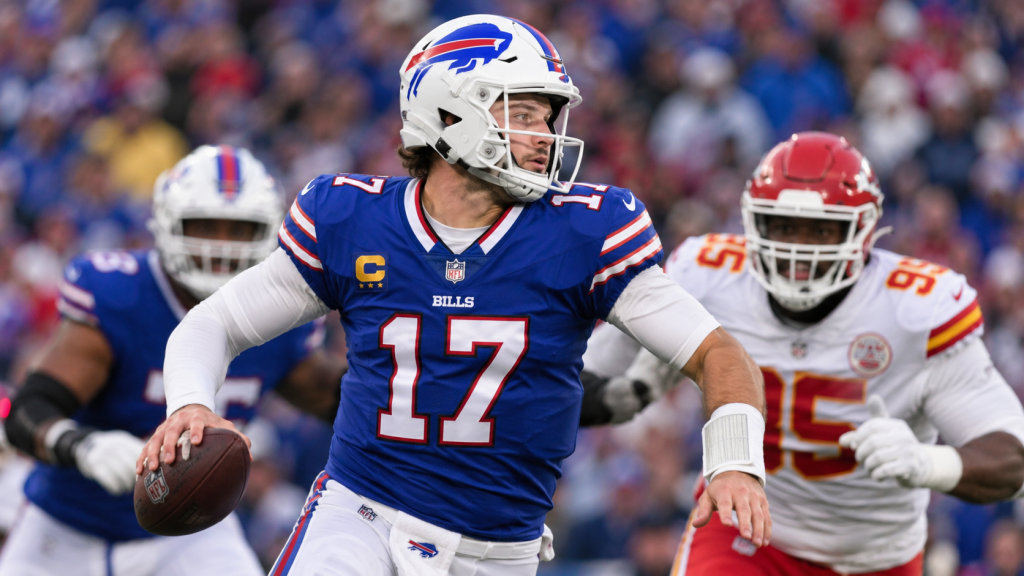
Josh Allen is giving the Buffalo Bills another reason to believe their offense can compete with the NFL’s best defenses. Through the first six games of the 2026 regular season, Allen has combined productive passing, dangerous rushing ability and improved adaptability against defensive schemes. His latest performance against the Las Vegas Raiders offered one of the clearest examples of that development.
As of October 23, 2026, Buffalo is 5-1 and entering its Week 7 bye after a 33-30 victory over Las Vegas on October 18. Allen has thrown for 1,504 yards, nine touchdowns and four interceptions, recording a 102.1 passer rating. He has also rushed for 240 yards and eight touchdowns on 48 carries.
Those numbers demonstrate his value as a dual-threat quarterback. However, the more interesting story is how he is adjusting when defenses try to take away his preferred options. Rather than relying exclusively on deep throws or designed runs, Allen has shown he can punish zone coverage with underneath passes, capitalize on openings and make defenses pay when plays break down.
Josh Allen’s Numbers Against Zone Coverage Tell an Important Story
Allen’s Week 6 performance against the Raiders provided the strongest recent evidence of his effectiveness against zone coverage. According to the Bills’ published breakdown of the game, Las Vegas played zone coverage on 19 of Allen’s 33 passing attempts. He completed 14 of those passes for 182 yards and two touchdowns.
That represents a completion rate of 73.7 percent on those attempts, with both of his passing touchdowns coming against zone coverage. Allen finished the game with 255 passing yards, two touchdowns, no interceptions and a 112.6 passer rating as Buffalo secured its fifth victory of the season.
The significance extends beyond the final numbers. Zone defenses generally aim to protect particular areas of the field, keep plays in front of defenders and limit the opportunities for explosive gains. Quarterbacks must recognize coverage patterns, identify available space and deliver the ball before defenders can close the passing lanes.
Against Las Vegas, Allen showed that he did not need to force difficult throws to remain effective. Buffalo used quick passes and underneath routes to attack the space available in the defense, allowing its playmakers to gain additional yards after the catch.
The Bills recorded 175 yards after the catch in the victory, providing further context for how the passing attack generated production. Allen’s contribution was not simply about arm strength. It was also about distributing the ball efficiently and allowing the offense to turn short completions into meaningful gains.
The Numbers Behind Allen’s Adaptability
Allen’s 2026 production provides several indicators of how his game is developing. His passing statistics show that he remains a productive downfield threat, while his rushing numbers demonstrate how difficult he can be to defend when he leaves the pocket or becomes part of the designed running game.
- 1,504 passing yards: Allen is averaging 250.7 passing yards per game through six appearances.
- Nine passing touchdowns: He has continued to produce scoring opportunities through the air despite facing different defensive approaches.
- Four interceptions: His turnover total remains an important measure to monitor as the season progresses.
- 240 rushing yards: Allen is averaging five yards per carry and remains capable of creating first downs when passing lanes disappear.
- Eight rushing touchdowns: His ability to finish drives himself gives Buffalo an additional scoring option near the goal line.
Combined, those figures give Allen 17 passing and rushing touchdowns through six games. The production is impressive, but the numbers also illustrate why his development should be evaluated through multiple measures rather than touchdowns or passer rating alone.
Advanced metrics can help explain how a quarterback produces those results. Passing grades, big-time throws, turnover-worthy plays, pressure-to-sack rate and performance against different coverage types each reveal something different about his decision-making and execution.
Pro Football Focus Grades Reveal Both Strengths and Areas to Improve
Pro Football Focus provides another perspective on Allen’s season through its proprietary grading system. Its published 2026 figures through Week 6 gave Allen an overall grade of 81.5, ranking ninth among 35 quarterbacks in its listed group. His passing grade was 70.4, while his rushing grade reached 91.5, the highest among 24 qualified quarterbacks in that category.
The difference between his passing and rushing grades is particularly interesting. Allen’s mobility remains a major advantage, helping Buffalo create opportunities even when the initial play does not develop as planned. His rushing production can also force defensive coordinators to account for him as a runner instead of concentrating exclusively on his receivers.
However, the passing grade suggests that his overall impact should not be confused with flawless execution. PFF’s tracking also listed seven big-time throws and 11 turnover-worthy plays through the six-game sample. These are proprietary evaluation categories rather than official NFL statistics, but they provide useful context: Allen continues to make high-value plays while still producing some decisions or throws that can expose the offense to risk.
For Buffalo, the next stage of improvement is about retaining the explosiveness that makes Allen dangerous while reducing avoidable mistakes. A quarterback does not need to eliminate every difficult throw, but better decisions about when to attack and when to take the available completion can make an already productive offense more consistent.
Why the Rams Game Made the Raiders Performance More Significant
Allen’s ability to adapt becomes clearer when his two recent road performances are considered together. Against the Los Angeles Rams on October 12, he rushed for 121 yards in Buffalo’s 37-34 victory. The Bills reported that 107 of those rushing yards came on scrambles, demonstrating how effectively he could turn broken passing plays into major gains.
That approach was much less available against Las Vegas. The Raiders concentrated on keeping Allen in the pocket, limiting his rushing production to just one yard. Rather than attempting to reproduce his previous week’s rushing performance, Allen responded by making productive throws against the defense in front of him.
He completed three of five passes when scrambling to pass for 63 yards and a touchdown, his highest such passing-yardage total in a game during the 2026 season at that point. He also completed 13 of 14 passes when his snap-to-throw time was 2.5 seconds or less, producing 128 yards in that category, according to the Bills’ game breakdown.
The contrast matters because it demonstrates that Allen’s value is not limited to a single offensive approach. When the Rams allowed opportunities for him to gain yards with his legs, he took advantage. When the Raiders worked to keep him in the pocket, he was able to deliver the ball quickly and attack the available passing windows.
How Zone Coverage Can Become a Problem for Opponents
Zone coverage is designed to make the quarterback work through structured defensive spacing rather than simply matching every receiver with an individual defender. Its effectiveness depends on defenders recognizing routes, maintaining their responsibilities and closing on the ball once it arrives.
Allen can make that approach difficult when he consistently identifies open areas and releases the ball on time. His arm strength gives him the ability to attack deeper windows, while his mobility can create uncertainty for defenders who must remain aware of a potential scramble.
Quick completions can also force a defense to defend more of the field after the catch. When receivers gain yards beyond the initial completion, the offense can move the chains without depending on a succession of low-percentage deep passes.
Still, one successful performance does not establish that Allen has solved every version of zone coverage. Defensive coordinators can change their personnel, disguise their intentions and adjust their pressure packages. The Raiders’ Week 6 numbers provide a strong single-game example, but a larger sample will be needed to determine how consistently Allen performs against different zone schemes throughout the season.
Buffalo’s Bye Week Provides an Opportunity to Build on the Progress
The Bills enter their bye week at 5-1, giving Allen and the offensive coaching staff an opportunity to evaluate the first six games before the schedule resumes. Reviewing how defenses have responded to Buffalo’s passing concepts could help the team identify which formations, route combinations and protection adjustments have been most effective.
Allen’s recent performances also offer a practical blueprint for the weeks ahead. Buffalo can preserve its explosive downfield passing game while continuing to use quick throws to exploit available space. His running ability remains an important weapon, but the Rams and Raiders games showed why the offense benefits when he can produce without having to rely on scrambling for significant yardage.
For the Bills, the priority should be sustaining that flexibility. Allen’s mobility can change defensive assignments, his arm can punish mistakes, and his ability to take shorter completions can keep drives moving when opponents give him fewer opportunities downfield.
The Verdict: Allen’s Evolution Is About More Than MVP Recognition
Josh Allen’s early 2026 performance offers measurable evidence of a quarterback who can influence games in several ways. His 17 combined passing and rushing touchdowns, efficient performance against zone coverage in Week 6 and contrasting performances against the Rams and Raiders all highlight his versatility.
The most compelling evidence is not simply that Allen can make spectacular plays. It is that he can respond differently when opposing defenses change their approach. His 14 completions on 19 attempts against the Raiders’ zone coverage provide a concrete example of that adaptability, while his rushing performance against Los Angeles demonstrates the danger of giving him opportunities outside the pocket.
There are still questions to answer. His four interceptions and the turnover-worthy plays identified by PFF show that consistency remains important, and six games are not enough to establish a definitive season-long trend against every coverage scheme.
Nevertheless, Allen is giving Buffalo a balanced offensive foundation. If he continues to recognize coverage, take the available throws and use his mobility selectively, the Bills will have a quarterback capable of challenging defenses with more than one solution. That adaptability, rather than MVP recognition alone, could prove critical to Buffalo’s ambitions as the 2026 season moves forward.
Discussion
0Be the first to share your thoughts on this story.