
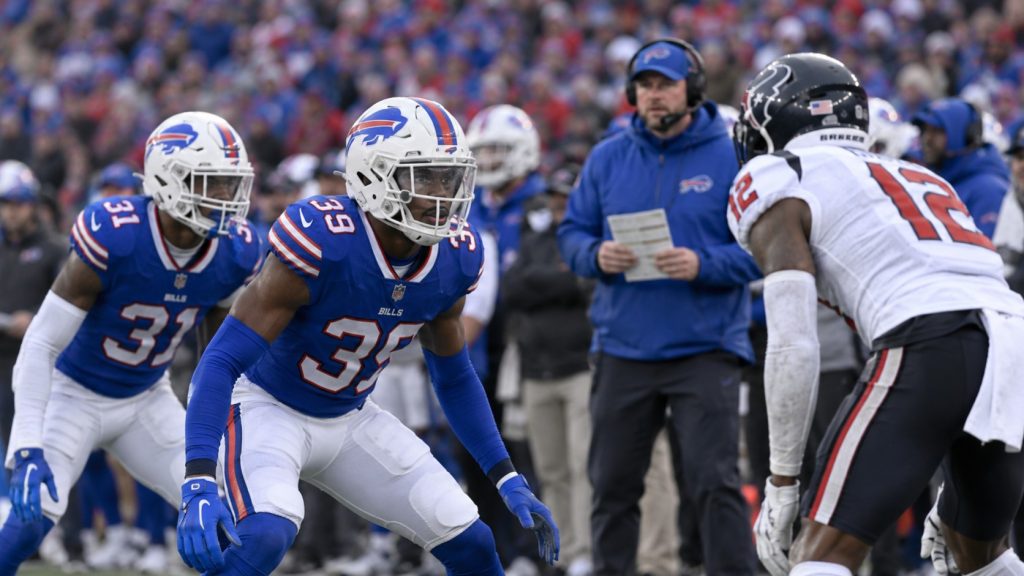
The Buffalo Bills are heading into their bye week with a 5-1 record, but their recent success has not eliminated concerns about the defense. Following a narrow 33-30 victory over the Las Vegas Raiders on October 18, questions remain about the identity, consistency, and execution of Buffalo’s secondary under first-year head coach Joe Brady and defensive coordinator Jim Leonhard.
Despite the idea that Brady is determined to preserve a confrontational defensive identity, the available evidence does not establish that he has made such a public commitment. Instead, Buffalo’s defensive numbers suggest a unit still searching for the right balance between physical coverage, tactical discipline, and reliable execution.
Buffalo’s Secondary Is Facing a Different Defensive Reality
The Bills entered the 2026 season with a new coaching structure following Sean McDermott’s departure. Brady took over as head coach after serving as Buffalo’s offensive coordinator, while Leonhard was brought in to lead the defense. Joe Danna serves as the secondary coach, placing the defensive backfield within a broader effort to establish a new system.
Through six games, Buffalo’s defensive approach has differed from its previous identity. Recent coverage data indicates that the Bills have played more base defensive personnel while relying heavily on Cover 3 and Cover 4. Those two coverage concepts have accounted for more than 60% of their defensive coverage calls, according to published analysis of the team’s first six games.
The most striking difference involves press coverage. Buffalo has pressed at least one receiver on approximately 14.1% of defensive snaps, ranking near the bottom of the league in that category. In 2025, the Bills used press coverage on 30.2% of their snaps, a figure that ranked among the league’s higher rates.
That change complicates the idea that Buffalo is simply doubling down on a confrontational approach. Physicality remains an important part of defensive football, but the current system has featured less press coverage rather than a clear increase in pressure at the line of scrimmage.
Why the Defensive Numbers Matter
The results explain why Buffalo’s defensive identity is attracting attention. Through six games, the Bills have ranked near the bottom of the NFL in several advanced defensive measures, including expected points added allowed per play and defensive success rate. These figures indicate that opponents have generally found it too easy to sustain productive drives against Buffalo.
Third-down defense has become another major concern. The Bills have allowed opponents to convert 45% of their third-down attempts, one of the league’s five-worst rates. During the victory over Las Vegas, the Raiders converted seven of 12 third-down opportunities, a 58.3% conversion rate.
Those figures matter because third-down stops determine whether a defense can get off the field and give its offense another opportunity. When opponents consistently extend drives, even an explosive offense led by quarterback Josh Allen can be forced to win high-scoring games rather than control them comfortably.
The problems cannot be assigned entirely to the secondary. Pass rush, defensive-line performance, communication, and play-calling all influence coverage results. However, the defensive backfield remains central to the challenge because coverage breakdowns can turn otherwise manageable situations into significant gains.
Joe Brady’s Role in Defining the Defensive Identity
As head coach, Brady is responsible for setting the overall direction of the team, but Leonhard oversees the defensive scheme and its weekly adjustments. That distinction matters when evaluating whether Buffalo should become more aggressive or maintain its current structure.
Before the Raiders game, Leonhard acknowledged that the defense had been inconsistent and indicated that his calls and personnel decisions were being evaluated. His comments pointed toward a willingness to examine what was not working rather than an intention to preserve the existing approach regardless of results.
The challenge for Brady and Leonhard is to determine which parts of the system deserve to remain and which require adjustments. An aggressive secondary does not necessarily have to blitz constantly or play press coverage on every snap. It must, however, make opponents work for completions, communicate assignments clearly, tackle consistently, and create difficult situations on critical downs.
Press coverage can disrupt a receiver’s timing, but it can also expose a cornerback to deep passes when the initial jam fails. Offenses can exploit predictable coverage calls, while defenders who do not communicate effectively can leave receivers open even when the original play design is sound.
For Buffalo, the goal should be purposeful aggression rather than aggression for its own sake. Selective press coverage, better disguise, appropriate personnel groupings, and improved coordination between the pass rush and the secondary could help the defense become more difficult to read.
The Bye Week Offers an Opportunity to Reset
Buffalo’s 5-1 start provides breathing room, but it should not obscure the defensive issues that have appeared during the opening six games. The bye week gives the coaching staff time to review film, evaluate player performances, adjust coverage responsibilities, and identify the situations in which communication has broken down.
Consistency should be a priority. The Bills do not need to overhaul every aspect of their defense to make progress. Reducing third-down conversions, limiting explosive passing plays, and putting defensive backs in clearer positions to succeed would be meaningful steps toward a more dependable unit.
The return of experienced players and decisions about defensive personnel could also influence how the secondary performs after the break. Any changes, however, will need to translate into improved results on the field rather than simply a different appearance on the play sheet.
What to Watch When Buffalo Returns
The Bills’ next stretch of games should offer a clearer indication of whether Leonhard’s defensive adjustments are producing progress. The most useful measures will be third-down stops, successful communication against changing offensive formations, fewer coverage breakdowns, and greater consistency against quality passing attacks.
Brady’s challenge is not necessarily to preserve a confrontational identity at all costs. It is to establish a defensive standard that suits Buffalo’s personnel and holds up against different opponents. That may involve more physical coverage in selected matchups, but it will also require discipline, adaptability, and sound execution.
The Bills have built a strong record behind an offense capable of controlling games, but their long-term ambitions will depend in part on whether the defense can become more reliable. For Buffalo’s secondary, the immediate task is clear: develop an identity that challenges opposing receivers without sacrificing coverage discipline, and turn that identity into measurable improvement.
Discussion
0Be the first to share your thoughts on this story.